Preparing for a mountain hike with your dog: what to know before you go
Mountain walks ask more of dogs than ordinary countryside routes. Here’s how to assess fitness, terrain, weather, livestock, water and route difficulty before setting out.
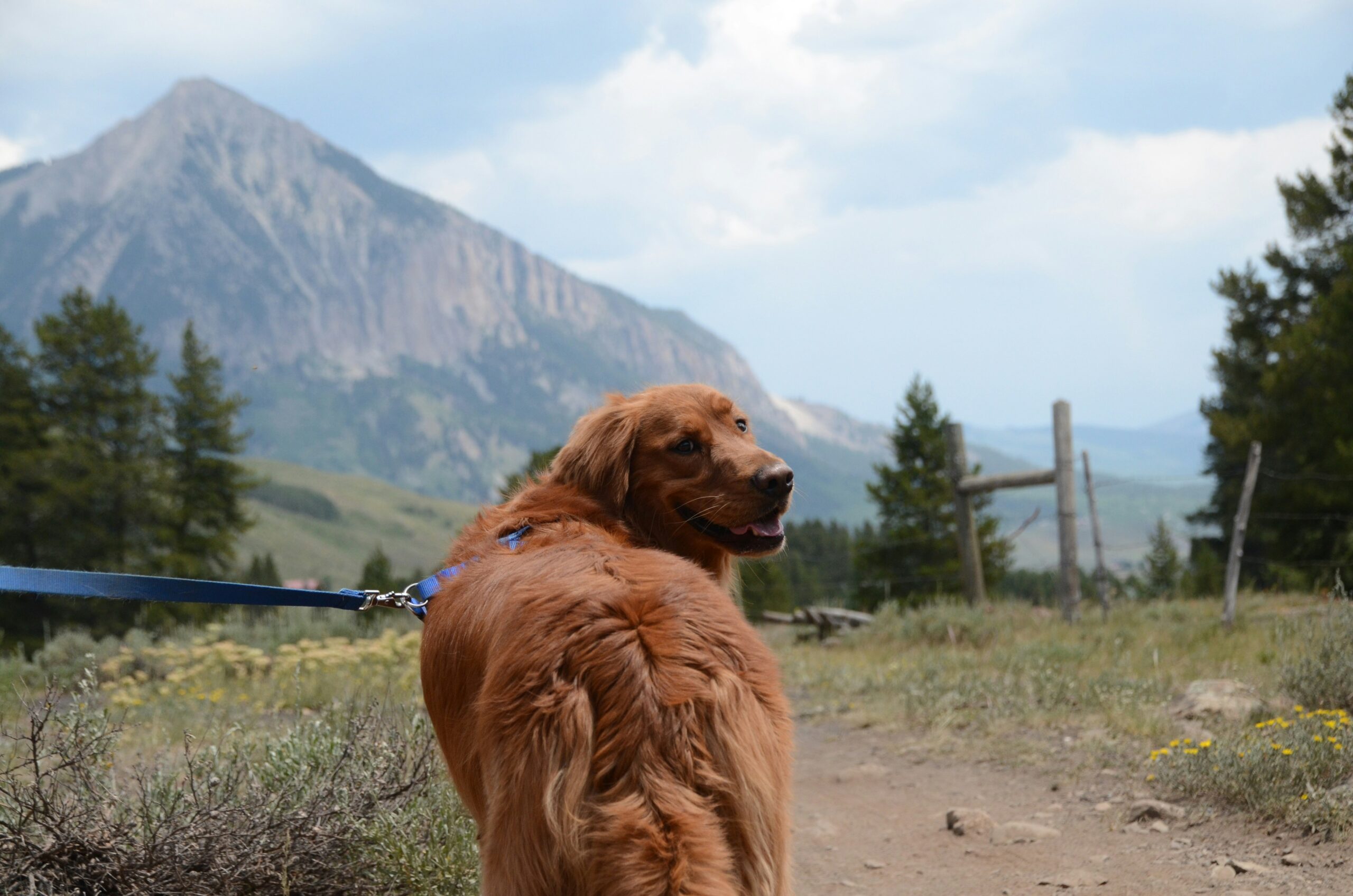
A mountain walk does not become suitable for a dog simply because dogs are allowed on it.
The more useful question is whether the terrain, distance and conditions suit the particular dog you are walking with.
Mountain routes can ask far more of a dog than ordinary countryside walks. A distance that looks perfectly manageable on paper can feel very different once you add sustained climbing, loose rock, exposed paths, limited shade and rapidly changing weather.
That does not mean difficult routes should be avoided. Plenty of fit, confident dogs are capable of handling long days in the hills. The important part is understanding what the walk actually involves before setting off — and being realistic about whether your dog has the fitness and experience to match it.
Is your dog ready for a mountain walk?
Enthusiasm and fitness are not quite the same thing.
Many dogs will happily keep moving because the walk is exciting, even when they are beginning to tire. A dog that spends an hour racing around a local field can still find several hours of continuous climbing unexpectedly demanding.
There is no particular mileage that makes a dog “mountain ready”. What matters more is what they are already accustomed to.
A dog that regularly walks several miles over hills, woodland and uneven ground has a much better foundation than one whose usual exercise is relatively short and flat. Building distance and difficulty gradually also gives you a chance to see how they cope with steep climbs, rough surfaces and longer periods on the move.
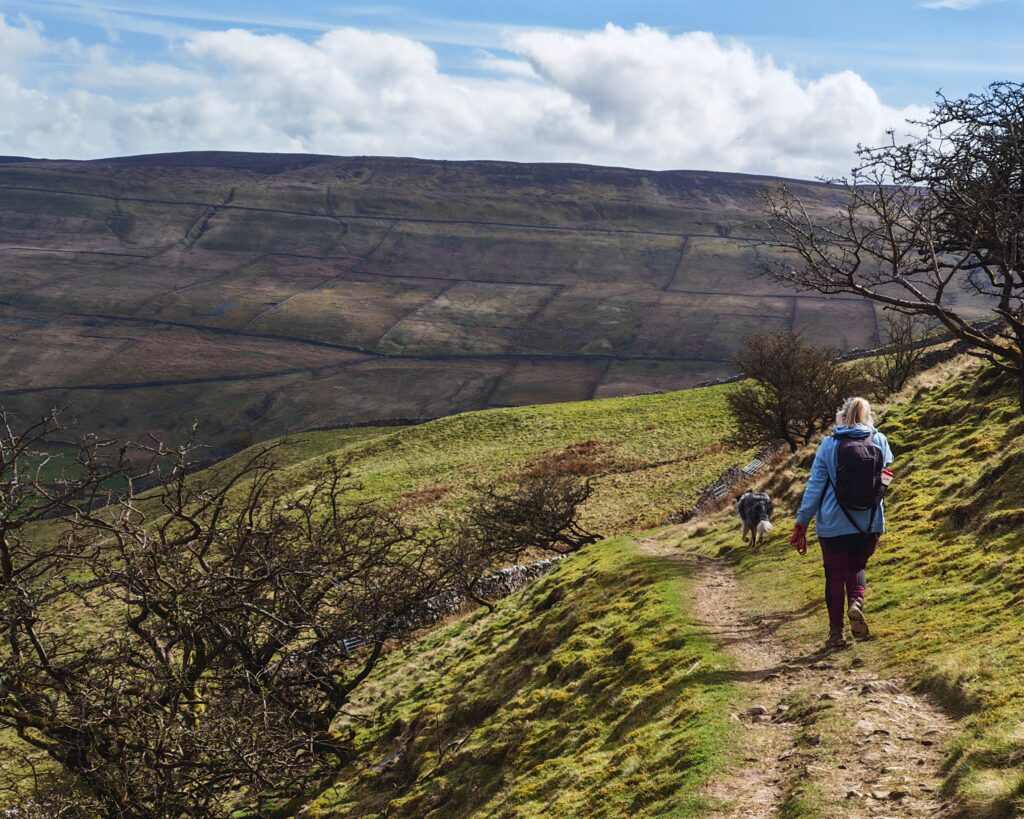
Recovery is worth watching too. Some dogs appear perfectly comfortable while they are outside but become unusually stiff or tired later that evening or the following morning. That can be a sign that the walk pushed them harder than it appeared at the time.
Age, mobility and general health all matter. Puppies and older dogs may need shorter routes, while dogs with joint or mobility issues can struggle with repeated climbing and descending even if the overall distance is not especially long.
If you are significantly increasing your dog’s usual level of exercise and you have any concerns about their health or mobility, getting veterinary advice first is sensible.
A short route can still be a hard route
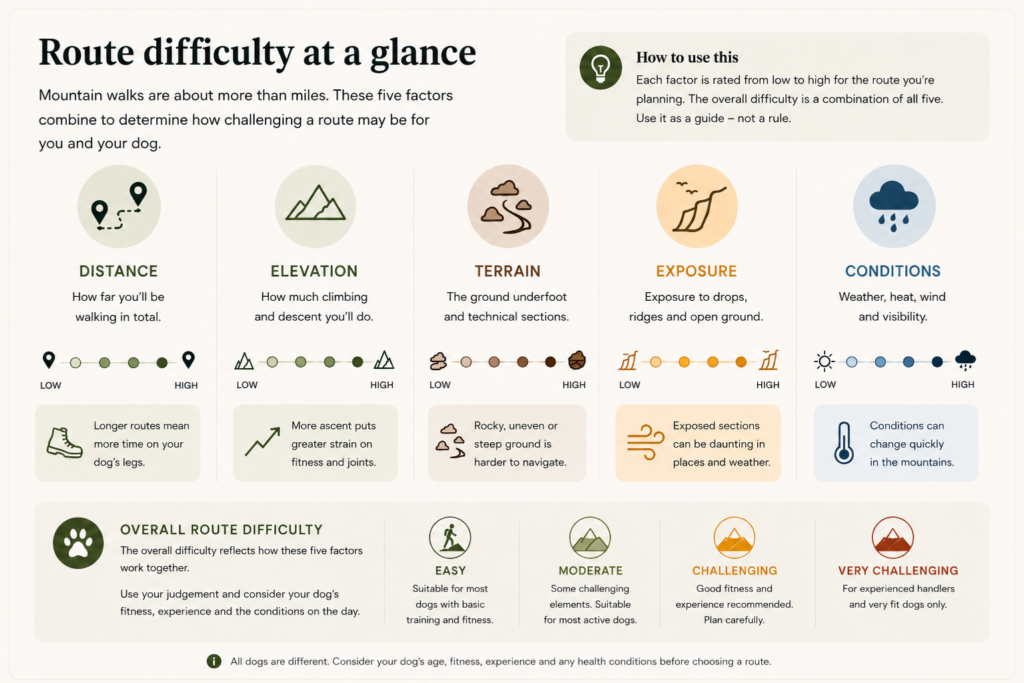
Distance is one of the easiest figures to compare between walks, but in the mountains it is also one of the most misleading.
A four-mile route involving a long ascent, steep rock and exposed ridges can demand considerably more than an eight-mile walk through relatively flat countryside.
Elevation gain gives some indication of how much climbing is involved, but the surface underfoot matters too. Loose stone, large rock steps and rough paths slow progress and require much more concentration from both walker and dog.
Exposure adds another layer. An open hillside may be physically demanding but relatively straightforward to navigate with a dog. A narrow ridge with steep ground below can require much closer control, even if the actual walking is not technically difficult.
Routes can also change character very quickly. A walk may begin on broad tracks before becoming progressively narrower, steeper or rockier as height is gained.
That is why it is worth looking at several factors together rather than relying on one headline figure:
- total distance
- elevation gain
- terrain
- exposure
- expected duration
- opportunities to turn back
Published walking times should be treated as guidance rather than a target. A dog may need additional water breaks, slower progress across rocks or simply more time to recover on a sustained climb.
The better question is not “Can my dog walk six miles?” but “Can my dog comfortably manage this six-mile route?”
Field-tested perspective
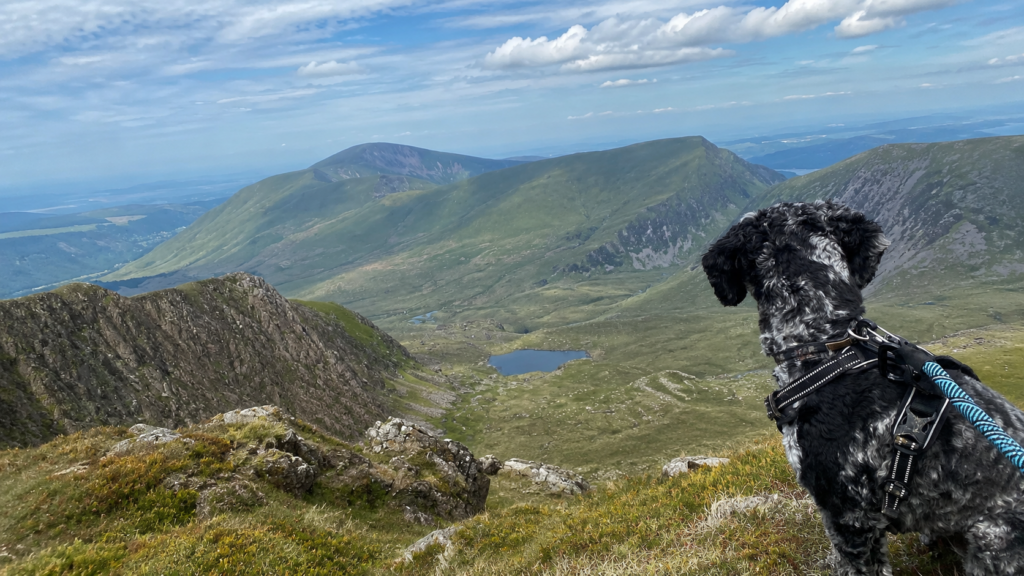
The Rhyd Ddu Path to Yr Wyddfa is a good example of why mileage alone can be misleading. The lower route is comparatively straightforward, but the higher sections become steeper, rockier and more exposed. That change in terrain is why BandiBoo assesses dog suitability separately from whether dogs are simply permitted on a route.
Terrain, livestock and keeping control
Dogs respond to difficult ground very differently.
Some naturally pick their way across rocks without hesitation. Others become cautious as soon as the surface becomes less predictable. Size and breed can offer clues, but confidence and previous experience often matter just as much.
Mountain routes can involve large rocks, loose stones, steep steps, wet slabs, narrow paths and occasional scrambling. A dog may be physically capable of getting over an obstacle but still be uncomfortable doing it.
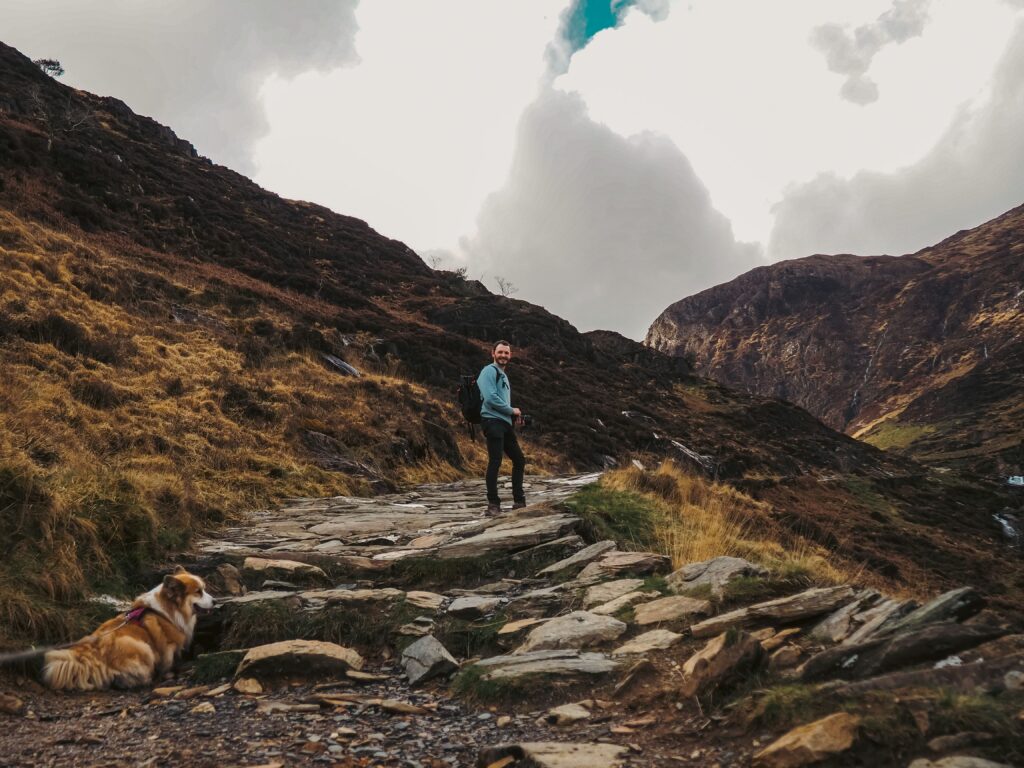
Watching how your dog reacts is more useful than assuming they should cope.
Control also becomes increasingly important as terrain becomes more serious. Even a dog with excellent recall may need to stay closer on narrow paths, beside steep drops or around busy summit areas.
A secure, well-fitting harness can be particularly useful in these situations because it allows closer control without relying entirely on the dog’s collar.
Livestock is another reason to remain flexible about lead use.
Many upland routes cross working farmland before reaching open mountain ground. Sheep are particularly common, but cattle and horses can also be encountered.
Dogs should be kept under effective control around livestock, and local signs and restrictions should always be followed. Keeping a dog on a lead around livestock is good practice, and on Open Access land it is a legal requirement. Dogs should never be allowed to chase, disturb or worry farm animals.
Livestock can also behave unpredictably around dogs. If cattle or horses become threatening, the Countryside Code advises releasing your dog rather than putting yourself at greater risk by trying to hold onto the lead. This allows both you and the dog a better chance of reaching safety.
It is also worth remembering that livestock changes through the year. A field that was empty on a previous visit may not be empty the next time you walk through it.
Worth knowing
Laws regarding livestock
Law update: In England and Wales, the Dogs (Protection of Livestock) (Amendment) Act 2025, which came into force in March 2026, strengthened the law around dogs worrying livestock and increased enforcement powers and penalties. Search the Act by name for the full current rules.
Weather, heat and water
Mountain weather deserves more attention than it sometimes gets when planning a dog walk.
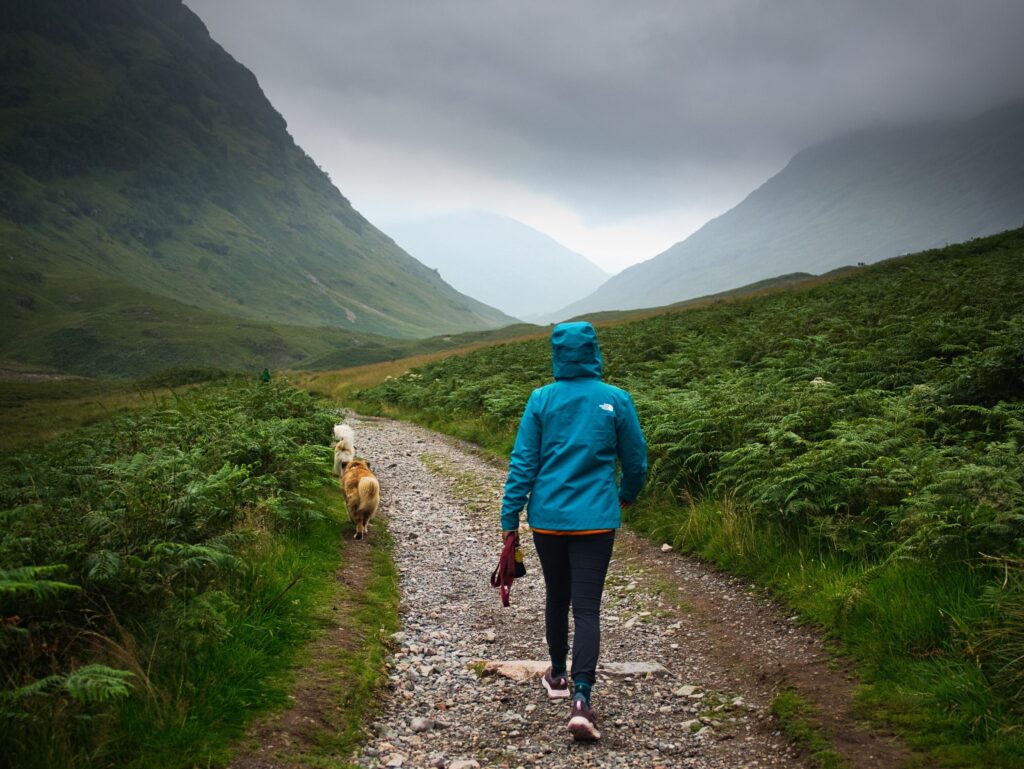
Conditions at the start can bear little resemblance to those higher up. A warm, calm car park can become a cold and windy summit a few hours later, while cloud and poor visibility can develop surprisingly quickly.
Always check a proper mountain forecast where one is available rather than relying only on the weather for the nearest town.
Heat can be just as important as cold.
Long climbs generate a lot of body heat and exposed hillsides may provide very little shade. Dogs cannot regulate temperature in the same way people do, so a route that feels merely warm to a walker can be much more demanding for a dog.
On warmer days, earlier starts can help, but the forecast temperature is only part of the picture. Humidity, shade, water availability and the dog’s coat and build all affect how comfortable they are likely to be.
Water should therefore be planned rather than left to chance.
Streams and ponds may look convenient, but natural water sources can dry up, become difficult to reach or be unsuitable for drinking. Carrying enough water for both walker and dog is the more reliable option.
A lightweight travel bowl makes regular stops much easier, especially on routes with no facilities.
The useful rule is simple: if you are not certain safe water will be available, assume it will not be.
What your dog needs on the mountain
A mountain kit does not need to be complicated.
The most useful items are the ones that solve predictable problems: safe control, hydration, weather protection and minor injuries.
A sensible starting point is:
- secure harness and appropriate lead
- drinking water
- lightweight travel bowl
- food or treats
- poo bags
- basic dog first-aid items
- weather protection where appropriate
- paw protection if your dog already uses it
Paws are particularly easy to overlook.
Rock and rough ground can be surprisingly abrasive over several hours. Check paw pads before setting off and look at them again during longer breaks, especially if your dog’s gait changes.
Dog boots can help in some conditions, but they are not something to introduce for the first time at the bottom of a mountain. Dogs need time to become comfortable wearing them, and fit matters.
The same principle applies to coats and harnesses. Equipment should be tested on shorter walks before it is relied upon during a long day out.
Food is worth carrying too. A demanding mountain route uses much more energy than a normal daily walk, and small amounts of food or treats can be useful during longer stops.
Do not build your plan around being able to buy refreshments on the mountain. Cafés and visitor centres can be seasonal, weather dependent or unexpectedly closed.
Both you and your dog should be equipped to complete the route without relying on them.
Know when to change the plan
One of the most useful pieces of mountain walking advice is also one of the simplest: reaching the summit is optional.
Weather changes. Dogs tire. Terrain sometimes turns out to be harder than expected.
Turning around does not mean the walk has failed.
There are plenty of reasons to change the plan:
- your dog begins to struggle
- the terrain becomes unsuitable
- weather deteriorates
- visibility drops
- you are running short of daylight
- water supplies are becoming limited
- someone in the group is no longer comfortable continuing
Dogs do not care whether a route reaches the summit. The pressure to finish usually comes from the people walking with them.
That makes it important to notice small changes before they become bigger problems.
A dog that normally walks ahead but suddenly starts lagging behind is communicating something. Repeated stopping, unusual panting, limping, reluctance to continue or changes in behaviour are all worth taking seriously.
Regularly check paws and make sure harness straps have not moved or started rubbing.
A short break may be all that is needed. Other times, the sensible choice is to turn around.
Quick check
Before you go
By the time you reach the car park, most of the important decisions should already have been made
- Is the distance and elevation appropriate for your dog?
- What does the mountain forecast say?
- Have they experienced similar terrain before?
- Is livestock likely?
- Is there reliable water or are you carrying everything needed?
- Are there exposed or difficult sections?
- Is your equipment suitable for the conditions?
- Do you have a map or reliable offline navigation?
- Do you know where you could safely turn around?
If several of those questions cannot be answered comfortably, a different route may be the better choice.
Mountain walking with a dog does not need to be complicated, but it does reward realistic planning.
The best walk is not necessarily the highest summit or the longest distance. It is the one where both walker and dog can manage the terrain comfortably, respond to changing conditions and still have enough energy to enjoy the journey back.
Put the advice into context
Related walks
Routes selected because this Guide is particularly relevant to planning or enjoying them.
Useful kit
Gear for this advice
Contextual products selected because they support the walking scenario covered above.
Pawtable · Bowls & Hydration
Pawtable 3-in-1 Dog Water Bottle
The Pawtable 3-in-1 Dog Water Bottle is designed to simplify carrying water on longer walks, hikes and full…
Keep reading
More useful guides
Walking your dog safely around wildlife
How to enjoy countryside walks with your dog while giving wildlife the space it needs, including advice around nesting birds, deer, waterways…
Read guide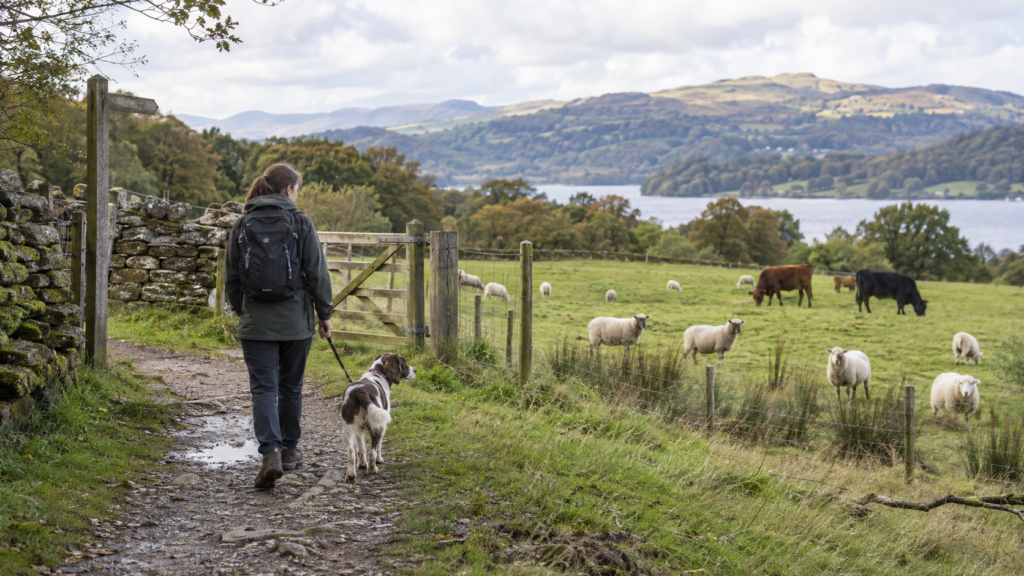
Walking Safely Around Livestock With Your Dog
Walking through farmland is part of what makes many countryside routes so enjoyable, but sharing fields and trails with livestock means taking…
Read guide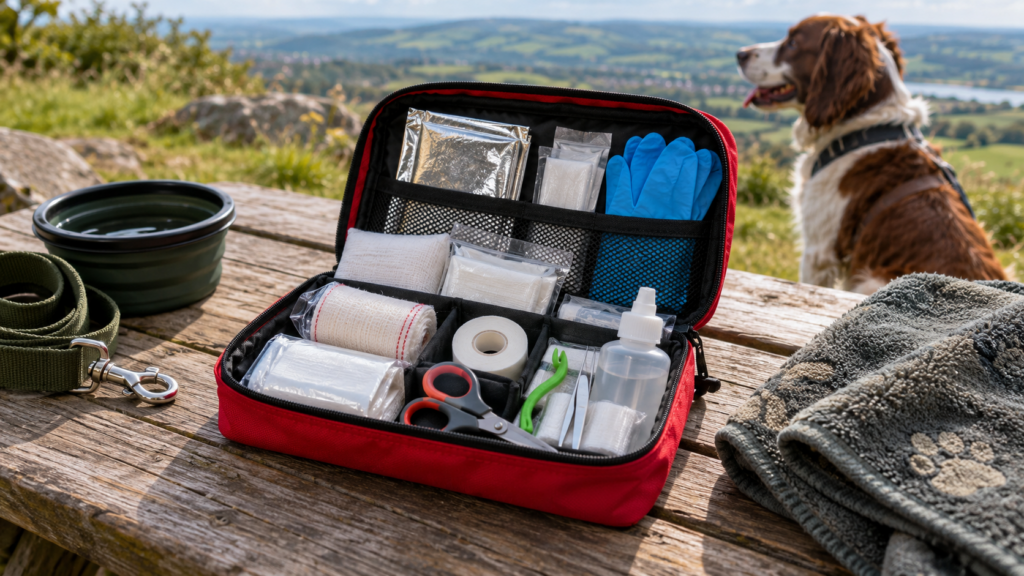
What to include in a dog first aid kit
A practical checklist for putting together a first aid kit for dog walks, days out and trips away.
Read guide